
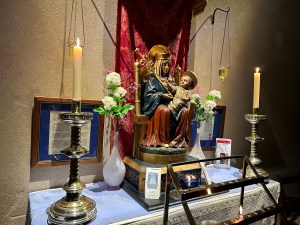
Cell of Our Lady of Walsingham
There is a Cell of Our Lady of Walsingham attached to the church. A votive mass to our Lady is said normally on the first Saturday of the month, at 8 am. The Angelus is also said regularly.
Every three months we have a special mass in honour of Our Lady of Walsingham. Each meeting starts with a mass followed by a shared breakfast.
This meets next on Saturday 1 August, 2026, at 9 am for mass followed by breakfast in the Rectory.
For more information about the story of Our Lady of Walsingham see here for the Shrine website in the UK.
From the May Newsletter:
Dear Friends
I BELONG to a clergy group called rather grandly the Society of Mary, Mother of Priests (SMMS). One of the aims of this group is to encourage the development of Marian spirituality, and this last week I had an occasion when I explored a Marian spirituality of which I knew nothing.
For last Tuesday, the 28 April, we celebrated Saint Peter Chanel, patron saint of Oceania, who died in 1841. He was a Marist. So I read up on the Marists. I must admit I inherited quite a lot of prejudice from my Irish Protestant grandmother against the teaching orders such as the Marists or the Christian Brothers, who were stocked, as I was told, by ignorant Irish who couldn’t even get a job in Ireland. So I had never been interested in the Marists or read about them.
The Society of Mary (Latin: Societas Mariæ), better known as the Marists, is a Catholic religious congregation of pontifical right. Founded in Cerdon, France, by Jean-Claude Colin, the Society of Mary was recognized by an apostolic brief on 29 April, 1836, and is made up of several branches (fathers, brothers, sisters, third order). So Peter Chanel died almost five years to the day since the order was recognised. The entry about their spirituality was as follows:
Marists present their spirituality and their way of living through a series of expressions, images and symbols.
“Hidden and unknown”: For Marists, being more or less “hidden and unknown” in the world, is a call to simple, modest and humble action. The focus on the task rather than who is doing it. For Fr Colin, the founder of the Society of Mary, being, “hidden and unknown” was the only way to do good.
“The Three Marist No’s: No to greed; no to pride; no to power.” Greed, power and pride limit the effectiveness of those who wish to present the Gospel of Jesus. Marists are invited to follow in Our Lady’s footsteps keeping their eyes fixed on God alone and on the kingdom, resisting the crippling forces of greed, power and pride so as to develop an inner freedom, and in the manner of Our Lady, build a Christian community which has Our Lady’s face.
“The three violets: Humility, simplicity and modesty”: spiritual attitudes. Marists must approach everyone in the same way as they approach God; “with an apron, a basin and a towel. To love and serve”.
“Mary in the Early Church”: Marist think of Our Lady in this group of believers at the beginning: with her faith and wisdom she had much to contribute to the life of the church, but in an unobtrusive manner.
“Compassion”: Marists consider that compassion must be expressed in actions. That it is through compassionate service that people will see Marists as disciples of Jesus and experience his love. Marists are invited to become “instruments of divine mercy”.
The Marists are called to imitate Our Lady in this way of life and ministry. Colin said Marists must “think as Mary, judge as Mary, feel and act as Mary in all things.”
Colin called the missionary and pastoral activity of the Marists the “Work of Mary”. According to Marist tradition the Society of Mary as a whole and every individual Marist is called to be an “Instrument of Mercy” for all people. As Mary was a healing presence in the Early Church so the Marists want to be present in the Church of their days.
Marian maxim “I (Our Lady) was the mainstay of the new-born Church; I shall be again at the end of time” began to circulate. The early Marists saw themselves as the ones to live and minister under Our Lady’s name. That was the core of the spiritual understanding of what they saw as their vocation.
This spirituality is very interesting. One point is that in part it states what they are against – the three no’s. Most Christian spirituality avoids negatives – think about the two great commands with their positives, you shall love …., rather than the ten commandments with their negative, you shall not… the reason for this is that we need to concentrate where we should be rather than what we are not. Too much emphasis on failure, too much emphasis on those who are different from us, can lead to bigotry or despair.
The other point was the three violets. I thought it was a translation error, but no, the word was “violets.” The reason this was chosen was because it was to emphasise humility – violets are simple flowers, and also it was a good teaching tool – you could pick a violet and talk about it, how it was simple and beautiful.
So I learnt about another Marian spirituality this week. One of the great things about belonging to our Cell here of Our Lady of Walsingham is that we are continually challenged to deepen our understanding of Our Lady and deepen our love for her Son.
For the Walsingham Subscriptions as in previous years, St George’s will collate our individual fees and then make a single payment to the Shrine to minimise exchange rate variations and bank fees. Could you therefore please transfer $65.00 for couples and $35 for individuals into the parish account, or alternatively provide cash to Tim Hender? The account details are BSB 105-033, Acc. No.151 992 640 and please include your name and ‘Walsingham’.
Our next mass followed by breakfast is Saturday 1 August at 9 am.
God Bless
Fr Scott
 St George the Martyr Anglican Church, Goodwood