
Cell of Our Lady of Walsingham
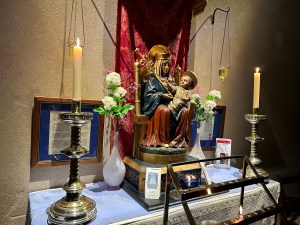
There is a Cell of Our Lady of Walsingham attached to the church. A votive mass to our Lady is said normally on the first Saturday of the month, at 8 am. The Angelus is also said regularly.
Every three months we have a special mass in honour of Our Lady of Walsingham. Each meeting starts with a mass followed by a shared breakfast.
This meets next on Saturday 1 November, 2025, at 9 am for mass followed by breakfast in the Rectory.
For more information about the story of Our Lady of Walsingham see here for the Shrine website in the UK.
From the August Newsletter:
Dear Friends
THERE IS A STORY about a meeting once on a train between the Archbishop of Canterbury and the Cardinal Archbishop of Westminster, the leaders of the English Anglicans and Roman Catholics. They once, by accident met in the same first-class carriage as they were travelling to London, so they had time to chat. During the time together the Cardinal asked the Archbishop what he thought the first words Our Lord would say to him when he reached heaven. The Archbishop replied that Our Lord would greet him and give him a copy of the bible, so he could catch up on the reading he had missed on earth. The Archbishop then asked the Cardinal what he thought Our Lord would say to him when he reached heave. “Oh, that’s simple,” the Cardinal said, “He would say, ‘Let me introduce you to my mother, I don’t think you have met her.’”
Knowing Our Lord and Our Lady go hand in hand in our tradition, yet sadly they have also divided Christians as well. But it is impossible to know Our Lord and not know his family, Joseph and Mary in particular. The Gospels, which after all only concentrate on the essential message, mention and talk about his relationship to his mother: John in his gospel always refers to her as the the mother of Jesus, and not as Mary for example.
In one of the famous miracle stories of the gospels, the healing of the woman with an issue of blood when Jesus is on the way to heal the daughter of Jarius, the only time when two miracles are reported together, at the end of the healing Jesus calls the woman daughter, drawing her form a nameless woman without family into his family. We are all called into his family – Our Lord deliberately gives us his prayer starting with Our Father, to emphasise this relationship. Therefore as we are part of his family, we need to know his mother and earthly father, Mary and Joseph. They were his models for his use of family.
Joseph gets a lot less attention as he disappears early in Our Lord’s life, but Mary plays an important part. John records her as being the cause of his first sign at the wedding at Cana, and records the last quote from her, “Do whatever he tells you,” words that cannot be a better guide for us. She then is at the foot of the Cross and Luke records her as being present in the upper room for Pentecost. As Christians at the mass we stand at the foot of the Cross when blood and water flow, and we too share in the Holy Spirit that came to us at Pentecost in Mary.
This month we will celebrate her major feast day on 15 August, a day that is called Mary, Mother of Our Lord by some (rather artfully suggesting somehow she was not the mother of God as defined at the Council of Ephesus in 431, to overcome the heresy of Nestorius and thus a suspect title) or the Falling Asleep or Dormition (the fancy Latin name) of Mary (a title favoured by some of our Eastern brethren) or the Assumption by Roman Catholics. The dogma of the Assumption was only defined in its present form in 1950 by Pius XII and is often taken to mean that Mary never died but was taken into heaven at the end of her life. That, however, is a simplification. This dogma was defined only recently because there has always been a lot of wriggle room about Mary’s death. It defines that Mary was assumed at the moment of death, therefore leaving it open whether she never died, or died, resurrected and then ascended. Anglicans have shown an acceptance of this dogma in our conversations with the Roman Catholics as it leaves this question unanswered.
So I invite you all who follow Our Lady of Walsingham to enjoy August, and the feast of Mary as we celebrate her life and her role to us. May we follow her good advice and do what ever Our Lord tells us, and know her as our mother when we reach the gates of heaven.
My thanks for our meeting this morning when we had nine for the mass and then six for the breakfast. Tim would like to remind anyone who has not paid their subscription to please do so. We received a lovely email thanking us from Walsingham for our recent payment.
I have attached to this newssheet a reflection done by one of the younger pilgrims to Walsingham recently.
Our next mass and meeting is Saturday 1 November at 9 am
God Bless
Fr Scott
A Refection from the Walsingham Website of the Recent Youth Pilgrimage
Charlotte Choley-Kovacevic
I had been to Lourdes several times before, and I remain deeply grateful for the grace those visits offered. Yet something about Walsingham touched me more deeply, and more subtly, than any other place of pilgrimage I have known. Perhaps it is the peculiarly English landscape: modest in its holiness, gentle in its invitation to pray. Perhaps it is that Walsingham doesn’t try to dazzle or overwhelm, even on this busy day, but instead draws the heart inwards. Whatever it is, I left Walsingham changed.
One moment in particular has remained with me in the very marrow of my spiritual life. It came just after I had received communion, in the stillness that followed the great procession and the solemnity of the Mass. I sat down in the grass, the taste of the Sacrament still in my mouth, and something in me fell utterly still. Around me, the sounds of the day – the choir, the shuffle of footsteps, the babble of a baby – seemed to fade away. For a few precious moments, there was only birdsong and the wind moving through the trees.
It was in that moment that I felt the presence of God more strongly than I had in a long time. Nothing particularly dramatic happened, but it was unmistakable – and I felt it in my chest, in my breath, in the very air around me. My eyes welled up, even as I tried not to let them, as the depth of God’s love came into sudden, piercing focus: a love so total and so intimate that it would take on the full weight of my sin and not flinch. A love that would die for me. For me.
I do not often think of God’s love as particular; I find it easier to imagine it in the abstract, like a blanket of goodness stretched over the world. But in that moment, in Walsingham, it felt pointed and deliberate – the love of a God who sees me and still chooses to love me, even to death and beyond. And somehow, I felt that this love had willed this place to be holy: through his mother, through her yes, through her steadfastness. The ground beneath me, the ruins around me, seemed steeped in centuries of prayer, sorrow and longing, joy and the aching hope of countless pilgrims.
What struck me most about the day was how ordinary it all seemed in many ways: the hymns, the words of the liturgy, the people around me. And yet, it revealed the sacred more clearly than any vision or voice from heaven. But it was enough. I didn’t need to see anything extraordinary. I simply knew that God is real, that he loves me, and that this world – even with all its ruins – is still a place where that love abounds.
We often think of pilgrimage as a journey outward to a sacred site, a holy place. But Walsingham reminded me that it is just as much a journey inward: a return not only to a shrine, but to the self who is seen and loved by God. In Walsingham, the love of Our Lady is made closer as she walks beside you, as a mother, gently leading you to her son. Mary said yes without knowing where it would lead, and I think part of Walsingham’s gift is the way it gives us space to say yes again – quietly, honestly, even uncertainly – to whatever path God places before us. It teaches us that the ruins still hold beauty, and that God’s love, carried on the wind and echoed in birdsong, is still strong enough to carry us home to the one who made us to love us.
Fidelium is a lay-led network of young Anglo-Catholic Christians in London and beyond, under the patronage of the Bishop of Fulham
 St George the Martyr Anglican Church, Goodwood